


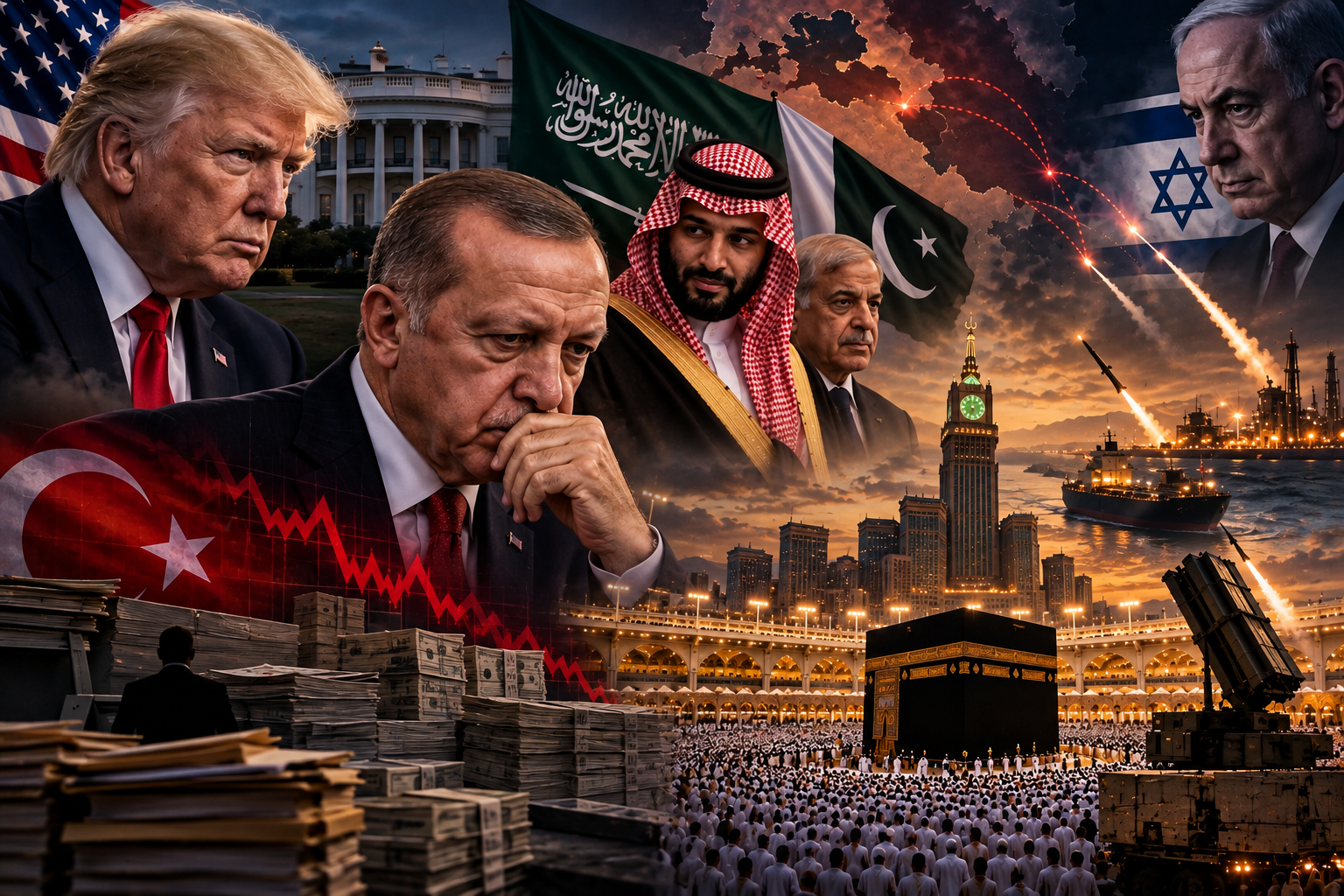
As Ankara emphasizes religious solidarity and regional defense, the agreement raises deeper questions about American strategic interests, Israel’s security, and Turkey’s vulnerability amid a major financial scandal.
The Mecca Joint Defense Agreement, signed by Turkey, Saudi Arabia, and Pakistan on August 7, 2026, is emerging as a consequential development in Middle Eastern security. Presented as an expression of collective defense and regional solidarity, the agreement has acquired renewed significance following Houthi attacks against Saudi Arabia.
Its name carries considerable symbolic weight. Mecca is Islam’s holiest city, and the language surrounding the alliance has emphasized solidarity with Saudi Arabia and the protection of holy sites.
Yet the agreement deserves scrutiny beyond its religious symbolism.
Three questions are particularly important. Whose strategic interests will the alliance ultimately serve? Could its operations indirectly advance Washington’s and Israel’s security objectives? And could Turkey’s domestic financial crisis make Ankara more susceptible to external pressure?
These questions do not establish that the agreement was secretly designed in Washington. They do, however, identify competing explanations for a major shift in Turkey’s regional security commitments.
The Religious Narrative and the Military Reality
The protection of Islam’s holy sites is a powerful source of legitimacy in Turkish political discourse. For an electorate sensitive to developments involving Mecca and Medina, a military commitment framed around safeguarding sacred places may appear fundamentally different from participation in a regional war.
But the agreement’s reported collective-defense provisions extend beyond the protection of religious sites.
Under the pact, an armed attack against one member is treated as an attack against all three. Following Houthi strikes against Saudi infrastructure, the participating governments announced measures to implement their defense commitments.
The distinction matters.
Protecting Mecca and Medina is one objective. Defending Saudi airports, energy infrastructure, military installations, and strategic transportation routes against an Iran-aligned movement is a considerably broader undertaking.
The latter places Turkey within a regional security confrontation involving Saudi Arabia, Yemen’s Houthis, Iran, and potentially the United States.
The religious dimension may be genuine. But it does not eliminate the agreement’s geopolitical implications.
Does the Pact Also Serve Israel’s Security?
The most sensitive question concerns Israel.
Turkey’s political leadership has frequently presented itself as a vocal critic of Israeli military policies. Yet foreign policy outcomes do not always correspond neatly to public rhetoric.
The Houthis are part of a regional confrontation involving Iran, Israel, the United States, and several Arab states. Measures that weaken the Houthis’ capacity to launch missiles or disrupt regional shipping could indirectly benefit multiple actors, including Israel.
A Turkish contribution to Saudi air defenses, intelligence gathering, surveillance, or military logistics could therefore produce consequences extending beyond Saudi territory.
This does not mean Turkey is entering an alliance with Israel.
Nor does it prove that protecting Israel is the agreement’s underlying purpose.
The more consequential issue is whether Turkish military capabilities might contribute to a regional security arrangement whose practical effects overlap with American and Israeli objectives, even while Ankara continues to criticize Israel publicly.
That possibility deserves examination because strategic cooperation can occur through parallel interests without a formal political partnership.
Washington’s Role: Pressure or Converging Interests?
The United States remains deeply involved in the security architecture of the Gulf.
Saudi Arabia’s defense, regional missile threats, maritime security, and the containment of Iranian military capabilities are longstanding American strategic concerns.
Turkey’s participation in a new collective-defense arrangement could potentially reduce the operational burden on Washington by increasing the contribution of regional partners.
It could also provide additional capabilities for a security framework designed to deter Iranian-aligned groups.
Reuters reported on October 7 that Turkey was providing predominantly defensive and technical support to Saudi Arabia. A U.S. official familiar with the matter described assistance involving strategic planning, logistics, drone operators, intelligence, surveillance, and reconnaissance.
The available reporting establishes a degree of coordination and awareness. It does not establish that Washington coerced Ankara into signing the agreement.
An alternative interpretation is that Turkey, Saudi Arabia, and Pakistan are attempting to construct a more autonomous regional security system.
Indeed, analysts at the Council on Foreign Relations have interpreted the Mecca agreement as evidence of regional powers developing security arrangements in response to declining confidence in the traditional U.S.-led order.
The central analytical challenge is therefore distinguishing between American pressure, strategic convergence, and regional autonomy.
These explanations are not necessarily mutually exclusive.
Turkey’s Fund Scandal and the Question of Political Vulnerability
The agreement is taking shape as Turkey confronts a serious financial and political controversy.
According to Reuters, Turkish regulators ordered the liquidation of 131 investment funds managed by seven asset managers after a crisis affecting nearly half a million investors.
The scandal has generated allegations of market manipulation, arrests, and political repercussions.
Fatma Betül Sayan Kaya, a senior official in Erdoğan’s ruling Justice and Development Party, resigned from her party positions following allegations concerning share-trading profits. She stated that she was assuming political responsibility while the allegations were examined.
These developments raise questions about regulatory oversight, political accountability, and the relationship between financial markets and political power.
They also invite a broader foreign-policy question.
Could a government facing a major domestic financial scandal become more vulnerable to diplomatic or economic pressure from powerful international partners?
In principle, financial instability can narrow a government’s room for maneuver. It can increase the importance of external investment, access to financial markets, diplomatic support, and international credibility.
However, the existence of financial vulnerability does not establish that another government has exploited it.
There is currently no publicly verified evidence connecting Turkey’s fund scandal directly to an American demand for participation in the Mecca agreement.
To establish such a connection would require evidence of diplomatic communications, explicit demands, financial conditions, or other demonstrable mechanisms of pressure.
Without that evidence, the relationship remains a hypothesis rather than a documented causal chain.
Nevertheless, the timing makes the interaction between domestic political vulnerability and foreign-policy decision-making a legitimate subject for investigation.
The Parliamentary Test
President Erdoğan announced on October 12 that the agreement would soon be submitted to Turkey’s parliament for ratification.
This creates an opportunity for public examination of its legal and military implications.
Several questions require answers.
Does the agreement impose automatic military obligations on Turkey? Under what circumstances could Turkish personnel be deployed beyond national borders? Who determines whether an attack against Saudi Arabia requires a Turkish military response? And what limits would apply to operations involving Yemen or Iranian-aligned armed groups?
Parliamentary review should also clarify the distinction between technical defense assistance and direct participation in hostilities.
These are not merely procedural questions.
They concern Turkey’s constitutional decision-making, military autonomy, and exposure to regional escalation.
The Risk of Strategic Entanglement
Turkey has substantial reasons to maintain close relations with Saudi Arabia and Pakistan.
Economic cooperation, defense exports, energy security, and regional diplomacy all provide incentives for closer ties.
But a collective-defense commitment can create obligations that extend beyond the circumstances originally anticipated.
An agreement presented as protection against attacks on Saudi territory could become increasingly difficult to separate from operations connected to Yemen’s civil war or the wider confrontation with Iran.
For Turkey, the danger is not necessarily immediate participation in offensive operations.
It is the possibility of gradually assuming responsibilities within a conflict whose political objectives and escalation dynamics Ankara cannot independently control.
That possibility becomes especially important when domestic financial instability and external diplomatic pressures are already subjects of political controversy.
Conclusion: Whose Security Is Turkey Defending?
The Mecca Defense Pact brings together several overlapping interests: Saudi Arabia’s territorial security, Pakistan’s regional commitments, Turkey’s strategic ambitions, American security priorities, and the wider confrontation involving Iran and Israel.
Its religious symbolism may help explain its political presentation. But symbolism alone cannot explain its military consequences.
The agreement could strengthen regional deterrence and protect civilian infrastructure. It could also draw Turkey into conflicts that complicate its relations with Iran and reduce its ability to act as a diplomatic intermediary.
Its operations might indirectly benefit Israel without establishing that Israel was the intended beneficiary.
Similarly, Turkey’s financial scandal could weaken the government’s political position without proving that Washington is exploiting that weakness.
The critical task is to investigate these relationships rather than assume them.
Ultimately, the most important question is not whether the agreement carries the name of Islam’s holiest city.
It is whether Turkey’s military commitments will be determined by clearly defined national interests and democratic oversight—or by a regional security confrontation in which Ankara’s own strategic priorities become increasingly difficult to distinguish from those of more powerful actors.


