


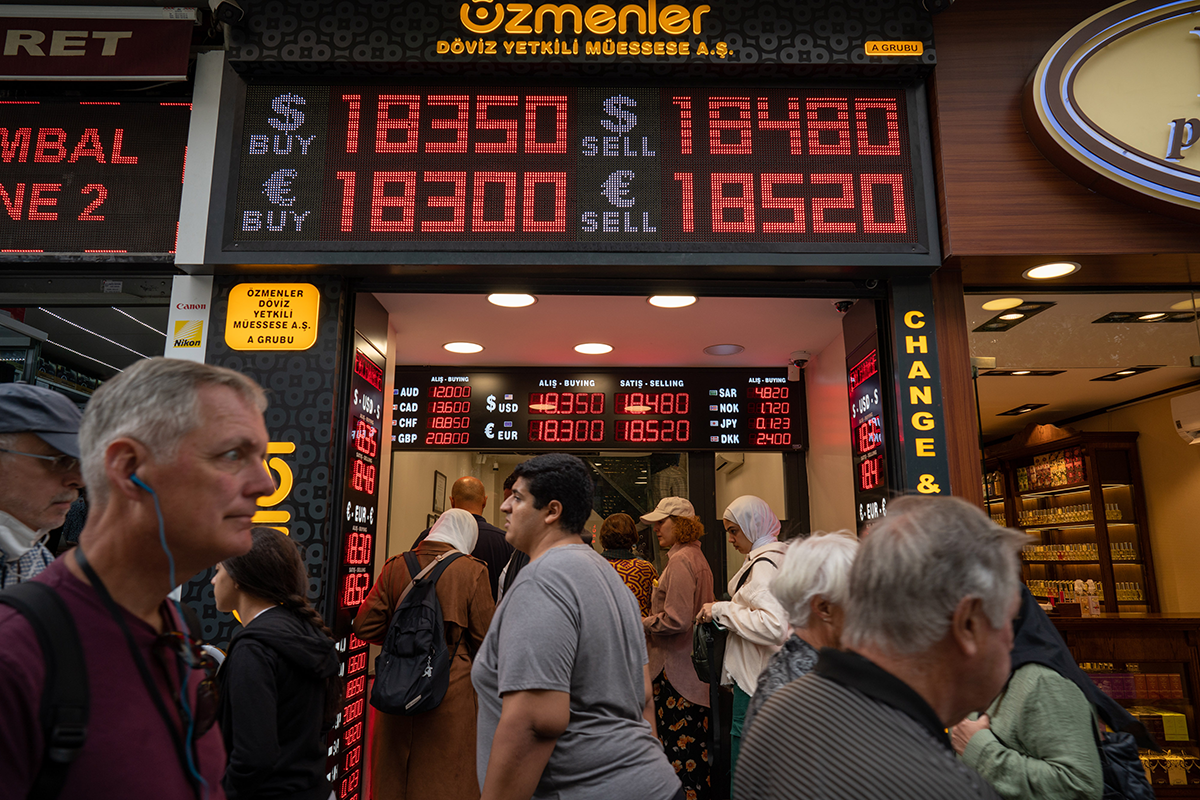
The liquidation of 131 investment funds, a sweeping criminal investigation and questions over illiquid stocks have exposed a deeper problem in Turkey’s economic normalization program: restoring confidence requires more than high interest rates.
For Mehmet Şimşek, Turkey’s economic normalization program was always supposed to be about restoring credibility.
Interest rates could be raised. Fiscal policy could be tightened. Domestic demand could be cooled. Inflation, eventually, could be brought under control.
But credibility is more difficult.
It depends not merely on monetary policy but on whether investors believe markets are transparent, regulators intervene before rather than after a crisis, asset prices reflect economic reality and the same rules apply to everyone.
The turmoil now surrounding Turkey’s investment-fund industry therefore presents Ankara with a problem that goes considerably beyond another bad week on Borsa Istanbul.
Turkey is confronting a crisis of confidence in the machinery of its capital markets.
And the numbers are extraordinary.
On September 17, the Capital Markets Board, or SPK, ordered the liquidation of 131 investment funds belonging to seven portfolio-management companies. The regulator later disclosed that 455,758 individual investors were invested in the affected funds. https://spk.gov.tr
The turmoil contributed to an approximately 8 percent fall in the benchmark BIST-100 during the week of the crisis. Borsa Istanbul subsequently announced its largest reshuffling of the BIST-100 in six years, removing more than a quarter of its constituents as authorities attempted to restore orderly pricing and investor confidence. Reuters
Then came the criminal investigations.
By September 26, Justice Minister Akın Gürlek said authorities had frozen assets belonging to 46 legal entities, 18 funds and 42 individuals, while 37 suspects had been subjected to judicial-control measures. Prosecutors are investigating allegations including aggravated fraud, money laundering, violations of capital-markets legislation and participation in a criminal organization. These remain allegations under investigation, not findings of guilt. Anadolu Ajansı
The investigation continued to expand on Sunday. Arrest warrants were issued for Tera Yatırım CEO Emir Münir Sarpyener and Tera Portföy Chairman Erdin Özel; Özel was subsequently detained. Anadolu Ajansı
But the arrests may not be the most consequential part of the story.
The more important question is much simpler:
How was such a system allowed to become this large in the first place?
The Problem Was Already Known
This is where the crisis becomes uncomfortable for Turkey’s regulators.
The SPK itself acknowledges that the warning signs did not suddenly appear in September 2026.
According to the regulator, beginning in the final quarter of 2025, certain investment funds—particularly hedge and money-market funds—were producing price movements in low-free-float stocks that could not be explained by the companies’ underlying economics or fundamental financial indicators.
The issue was serious enough to be discussed at the Financial Stability Committee chaired by Şimşek on December 2, 2025. https://spk.gov.tr
That chronology matters enormously.
Because it changes the question.
The question is no longer simply:
What went wrong?
It becomes:
When did the authorities know something was wrong, and why did the problem become a market crisis before it was contained?
The SPK says it subsequently developed new regulations, consulted Borsa Istanbul, Takasbank, the Central Securities Depository and market participants, changed valuation rules in July and issued a comprehensive investment-fund guideline on August 28.
The regulator explicitly says the measures were designed to restrict manipulation through funds, prevent unsecured transactions between related parties and contain systemic risks created by abnormal stock-price movements. https://spk.gov.tr
Those measures may ultimately strengthen the market.
But their chronology also demonstrates that regulators had identified structural vulnerabilities months before the September turmoil.
That deserves scrutiny.
The Illiquidity Machine
At the center of the problem is a relatively simple market mechanism.
Imagine a stock with very few shares freely available for trading.
An investment fund accumulates a large position in that stock. Because supply is limited, additional purchases can push the market price sharply upward.
The fund then appears increasingly valuable because the stock it owns is increasingly valuable.
More investors notice the extraordinary returns.
More money enters the fund.
The fund can then buy more of the same illiquid assets.
The apparent success begins feeding itself.
But there is a fundamental weakness.
A quoted market price is not necessarily the price at which a very large position can actually be sold.
A fund may therefore appear to own billions of lira in assets at prevailing market quotations while discovering, when investors suddenly demand their money back, that those assets cannot be liquidated anywhere near those prices without causing them to collapse.
That is the difference between valuation and liquidity.
And when investors rush for the exit simultaneously, the distinction becomes brutal.
Reuters reported that the September turmoil began after a small number of funds struggled to meet redemption requests, contributing to forced selling and fears of contagion through the wider market.
What initially looked like spectacular investment performance therefore collided with the oldest rule in finance:
An asset is ultimately worth only what somebody is prepared to pay for it when you need to sell it.
Why This Matters Beyond the Stock Exchange
Turkey could treat this episode as a financial scandal involving a limited group of funds.
That would be a mistake.
Because Şimşek’s economic program depends heavily on precisely the commodity that this episode threatens:
trust.
Turkey needs foreign capital.
It needs Turkish households to keep their savings inside the formal financial system.
It needs international investors to believe that prices on Borsa Istanbul reflect supply, demand and corporate fundamentals rather than concentrated positions in thinly traded shares.
And it needs regulators to be perceived as referees rather than emergency responders.
This is particularly important because Turkey is simultaneously asking investors to accept another difficult proposition.
The government says the country has returned to conventional economic policy.
The central bank is maintaining tight monetary conditions. Inflation remains painful. Growth is slowing. Households are being asked to endure the consequences of stabilization.
The implicit promise is that this pain will eventually produce a more predictable economy.
But predictability cannot exist only at the central bank.
It must exist throughout the financial system.
Şimşek’s Two Credibility Problems
This leaves Mehmet Şimşek facing two separate credibility tests.
The first is macroeconomic.
Can Turkey bring inflation down without Erdoğan abandoning monetary discipline when the political cost becomes uncomfortable?
The second is institutional.
Can Turkey convince investors that its markets are transparent, properly supervised and capable of correcting abuses before they become systemic problems?
The first problem can partly be addressed with interest rates.
The second cannot.
No central-bank rate can compensate for doubts about price discovery.
No fiscal target can substitute for confidence in market supervision.
And no foreign investor evaluating Turkey will completely separate macroeconomic orthodoxy from the institutional environment in which capital is expected to operate.
That is why the investment-fund crisis matters far beyond the investors directly affected.
Ankara’s Response Is Significant
There is another side to the story.
The authorities are not ignoring the crisis.
The SPK has liquidated the affected funds, introduced new rules and altered valuation practices. Borsa Istanbul has changed its criteria for its major indices, including additional requirements concerning volatility and shareholder equity. Market professionals cited by Reuters argued that the changes could improve price formation and make Turkey’s benchmark indices healthier representations of the market.
Prosecutors, meanwhile, are pursuing an increasingly broad investigation.
Those interventions matter.
A functioning market system is not one in which misconduct never occurs. It is one in which regulators identify it, courts investigate it and rules are changed when vulnerabilities become apparent.
The real test will therefore be what happens next.
Will the investigation establish how the questionable structures developed?
Will investors learn who benefited?
Will regulators explain why warning signs identified in 2025 did not prevent the September 2026 liquidity crisis?
And, perhaps most importantly, will the reforms change the incentives that produced the problem?
The Erdoğan Dimension
There is also an unavoidable political dimension.
Justice Minister Gürlek said President Erdoğan is closely following the investigation. The government’s declared priority is protecting citizens’ savings and addressing investor losses within the framework of the law.
But presidential attention cuts both ways.
It demonstrates that Ankara recognizes the seriousness of the crisis.
It also reinforces a longstanding question about Turkey’s economic governance: Can institutions establish credibility independently, or does every major crisis ultimately require intervention from the political center?
For international capital, that distinction matters.
Strong institutions do not merely punish wrongdoing after political authorities demand action.
They detect risk routinely, apply rules predictably and intervene regardless of who is involved.
That is what institutional credibility means.
From Inflation to Institutions
Turkey has spent the last three years attempting to persuade the world that the era of economic experimentation is ending.
Şimşek’s return was central to that message.
But the next stage of Turkey’s normalization cannot simply be about the level of interest rates.
It must be about institutions.
The central bank must be credible.
The statistics must be credible.
The budget must be credible.
And the capital markets must be credible.
Otherwise Turkey risks achieving something paradoxical: orthodox monetary policy operating inside a financial system that investors still perceive as unpredictable.
That would leave Şimşek with only half a normalization program.
The liquidation of 131 funds therefore represents more than a financial cleanup.
It is a test of whether Turkey’s economic institutions can identify their own weaknesses, explain how they developed and demonstrate that the rules governing markets are stronger than the networks operating inside them.
The investigation will determine whether crimes were committed and by whom.
But the larger economic question already exists.
Turkey has spent years trying to restore confidence in its economic policy. Now it must prove that investors can also have confidence in the market itself.
And that may be the harder reform.


