


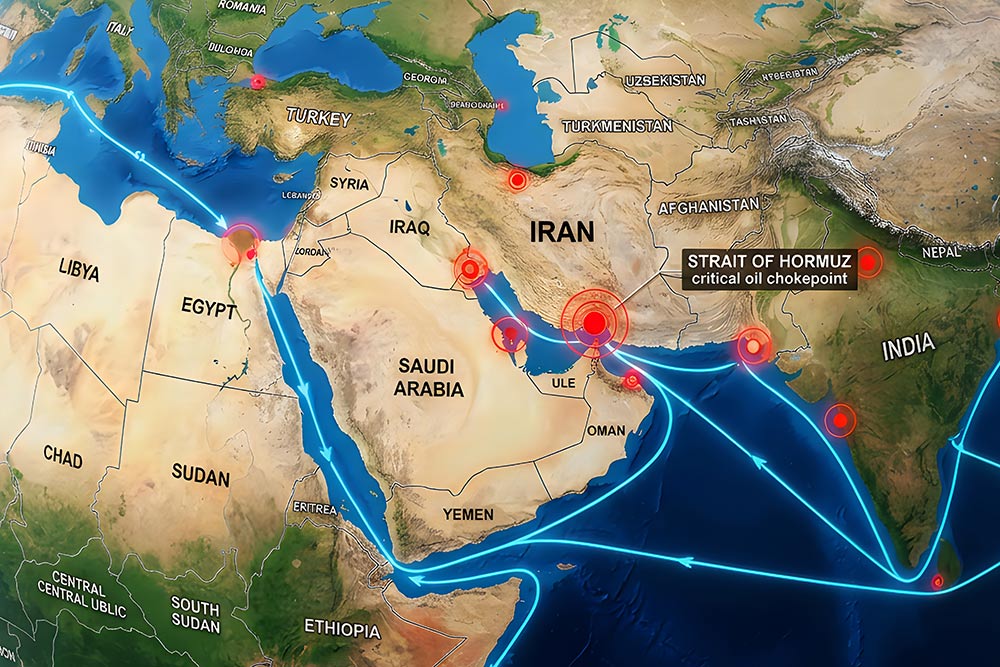
The crises unfolding one after another across the Middle East can no longer be understood as separate wars being fought in unrelated theaters. Gaza, Lebanon, Yemen, Iraq, Iran, the Gulf, and the Red Sea are becoming parts of a single conflict network in which military calculations, energy security, international trade, and the future of American influence are increasingly intertwined.
The greatest risk today is not simply that the war will spread to new fronts. It is that a conflict once waged primarily across battlefields is evolving into a struggle over transit routes and strategic corridors. The Strait of Hormuz, Bab el-Mandeb, the Suez Canal, and oil pipelines are no longer merely components of the region’s energy and trade infrastructure. They are becoming strategic instruments through which regional actors can exert pressure on a global scale.
From Battlefronts to Strategic Chokepoints
Bab el-Mandeb is one of the most critical links connecting the Indian Ocean to the Red Sea and the Mediterranean. A prolonged disruption of maritime traffic there would mean far more than ships changing course. It would also drive up insurance and transportation costs, lengthen transit times, and force a reorganization of global supply chains.
The Strait of Hormuz remains one of the most vulnerable points in the global energy market. If tensions in Hormuz and pressure on maritime traffic through Bab el-Mandeb intensify simultaneously, they could create a new strategic equation best described as a “double chokepoint.” Under such conditions, a substantial share of global energy and trade flows would become vulnerable to military or political decisions taken within a remarkably confined geography.
This is also changing the very nature of power. Possessing a large army or controlling vast territories is no longer enough. An actor capable of disrupting a single maritime passage or threatening one energy facility can generate economic consequences far beyond what its conventional military strength might suggest.
Washington: Between Deterrence and Control
The publicly reported contacts between the United States and the Houthis reveal Washington’s fundamental dilemma over the tensions emanating from Yemen. The United States wants to defend freedom of navigation and protect its international interests. At the same time, it does not want the Red Sea to become an open military front that drags it into another prolonged war.
Washington’s approach therefore appears closer to risk management and containment than to the pursuit of a comprehensive military victory.
This approach, however, is exposing differences in priorities between the United States and its Gulf allies. Saudi Arabia views the Houthi threat as directly linked to its national security. From Riyadh’s perspective, the issue is not limited to maritime security; it also concerns the protection of oil facilities, ports, and export routes.
Washington, by contrast, is focused primarily on preserving international freedom of navigation and safeguarding its own direct interests.
This divergence does not mean that the US-Saudi alliance has collapsed. It does, however, point to a significant change in the nature of the relationship: Washington expects its allies to assume greater responsibility for their own security, while the Gulf states are demanding clearer and more actionable security guarantees from the United States.
Saudi Arabia Under Pressure from Two Directions
If pressure originating from Iraq intensifies at the same time as threats from the south, Saudi Arabia could find itself drawn into a far more complicated security equation.
Riyadh would then face not a single front, but a broad network of threats stretching from the Gulf to the Red Sea.
This situation also highlights a defining feature of modern warfare: defending strategic infrastructure can be far more expensive than attacking it. Protecting airports, ports, oil facilities, pipelines, and sea lanes simultaneously requires an extensive and costly security architecture. A relatively limited strike, by contrast, can produce disproportionately large economic consequences.
Oil: The Heart of the Global Equation
Energy lies at the center of all these developments.
Oil is not merely a commodity traded on global markets. It is a fundamental input for transportation, industry, petrochemicals, and agriculture. A prolonged disruption in oil supplies would therefore not only affect prices directly, but also raise the cost of goods and services, placing additional pressure on inflation, interest rates, and economic growth.
Major economies can draw on strategic reserves to soften the initial shock. Those reserves, however, are not a permanent substitute for sustained supply losses.
The longer the crisis continues, the more difficult the market equation becomes: supply falls, demand persists, and upward pressure on prices intensifies.
The real struggle, therefore, is not simply about how much oil lies underground. It is about whether that oil can be produced, transported, and delivered safely to global markets.
Europe and Egypt: Outside the War, Inside Its Costs
The consequences of the crisis may become increasingly visible in Europe. For a continent still restructuring its energy system after the Russia-Ukraine war, another surge in oil and natural-gas prices could raise costs across industry, transportation, and agriculture.
For Egypt, the risk is more immediate.
The Suez Canal is one of the country’s most important sources of foreign currency. If security problems in the Red Sea cause ships to use alternative routes for an extended period, Cairo could suffer serious losses in desperately needed foreign-exchange revenue.
Egypt thus faces a significant geopolitical paradox: it may not be a direct party to the war, yet it could increasingly be forced to bear its economic costs.
Israel and the Redefinition of the Conflict
Current developments cannot be separated from the regional transformation set in motion by the war that followed the October 7, 2023, attacks. The war in Gaza has expanded the framework through which the conflict is understood, linking it to a wider regional equation that includes Lebanon, Yemen, Iraq, and Iran.
Within Israel, the security failures preceding October 7 have sparked an extensive debate over the performance of the country’s intelligence services and political decision-making mechanisms. How the Israeli government assessed warnings before the attack remains a matter requiring independent investigation and evidence before definitive conclusions can be reached.
What is clear, however, is that Israel adopted a more aggressive security doctrine after October 7. Rather than waiting for threats to reach its borders, it has emphasized neutralizing them at an earlier stage.
The larger question is whether Israel is attempting to build a new order of deterrence, or whether its expanding military operations are producing a more unstable and hostile regional environment.
The rhetoric of “Greater Israel” must also be considered in this context. Yet ideological aspirations must be distinguished from viable state policy. Territorial expansion may offer short-term tactical gains, but it could also impose much greater security, political, and economic costs over the long term.
The United States and the International System
For Washington, the issue is no longer confined to the Middle East.
The United States remains the military power with the greatest capacity for global intervention. Yet risks emerging simultaneously across multiple theaters—and the rising cost of defending American interests—are forcing Washington to reconsider the nature of its military presence in the region.
This could mean a transition from direct, permanent deployments toward a more flexible military model built around aircraft carriers, long-range strike capabilities, and bases located beyond immediate threat zones.
That does not automatically mean the end of American influence.
A more accurate description may be that the world is moving toward a more competitive, multipolar, and unpredictable international order.
Alongside China and Russia, regional actors now possess tools capable of affecting Washington’s calculations. Moreover, they do not always need conventional military power on the scale of the United States to do so.
The Greatest Risk: Interlocking Crises
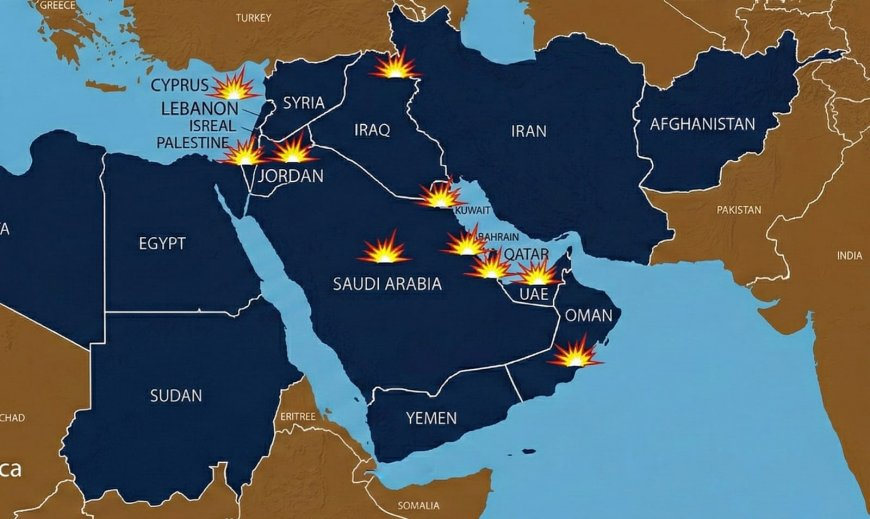
The greatest danger in the present landscape is that these crises are no longer independent of one another.
The war in Gaza affects Lebanon.
Tensions with Israel are linked to Iran.
Iran is linked to Gulf security.
The Gulf is linked to the Strait of Hormuz.
Yemen is linked to Bab el-Mandeb.
Bab el-Mandeb is linked to the Suez Canal.
And the Suez Canal is part of the global trade chain connecting Asia and Europe.
What has emerged, therefore, is not a collection of individual crises, but a single network of mutually reinforcing risks.
The central question is no longer which front will be won. It is whether regional and global powers can prevent the conflict from leaping from one theater to another—from a security crisis to an energy crisis, and from an energy crisis to a broader economic crisis.
Conclusion: The Middle East Is Being Reshaped
The Middle East is entering a new period of transformation. Today’s struggle is no longer fought solely over territory and borders. Corridors, energy networks, ports, pipelines, and trade routes have moved to the center of the contest for power.
Perhaps the defining paradox of this era is that an actor no longer needs to control a vast territory to wield global influence. The ability to threaten a single strategic chokepoint can produce consequences far beyond that actor’s geographic reach or conventional military strength.
The corridor stretching from Hormuz to Bab el-Mandeb, and from the Red Sea to Suez, has therefore become one of the most vulnerable arteries not only of the Middle East, but of the global economy.
The future of the Middle East will not be determined solely by outcomes on the battlefield. The decisive question will be whether the parties can prevent the war over strategic corridors from becoming a global energy crisis—and that energy crisis from becoming a crisis of the international system itself.


